


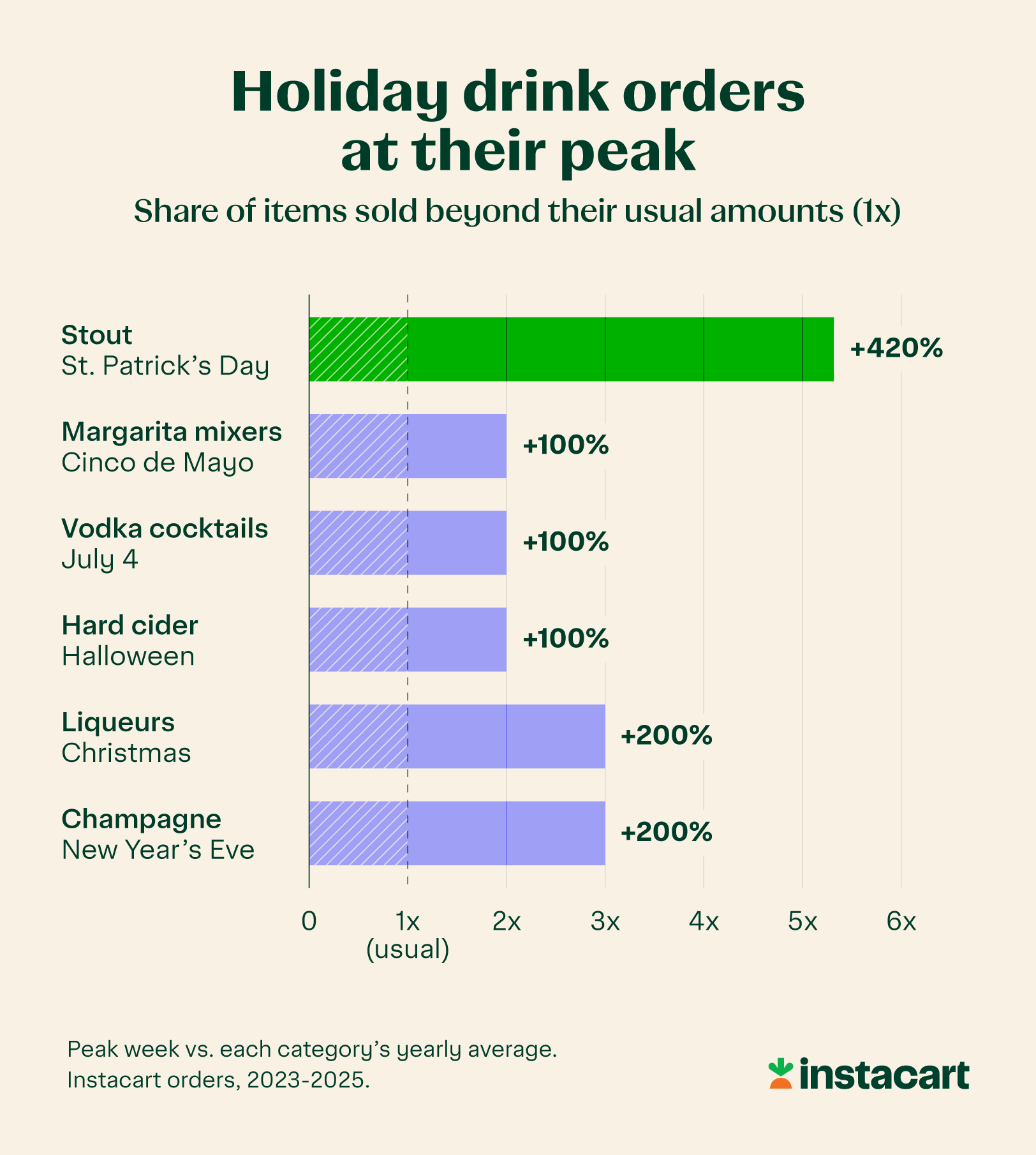
Holidays drive alcohol ordering trends. Stout’s share of Instacart orders jumps fivefold the week of St. Patrick’s Day, Champagne triples at New Year’s Eve, and canned cocktails double around July 4.
We looked at 3 years of Instacart orders, from 2023 through 2025, to find the biggest holiday spikes in alcohol purchases and what people buy with each bottle. Here’s what the data shows and how to plan your next holiday order.
Alcohol is for adults 21+, where available. Enjoy responsibly.
Key findings from Instacart's alcohol ordering data
St. Patrick’s Day has the biggest spike. Stout’s share of orders jumped to about 5 times normal the week of March 17, the largest repeated holiday spike in the data.
New Year’s Eve is the sparkling wine holiday. Champagne’s share of orders tripled that week, and about 1 in 6 Champagne orders included orange juice, likely for New Year’s Day mimosas.
July 4 is the canned cocktail holiday. Canned vodka cocktails showed up in about twice their normal share of orders that week, every year.
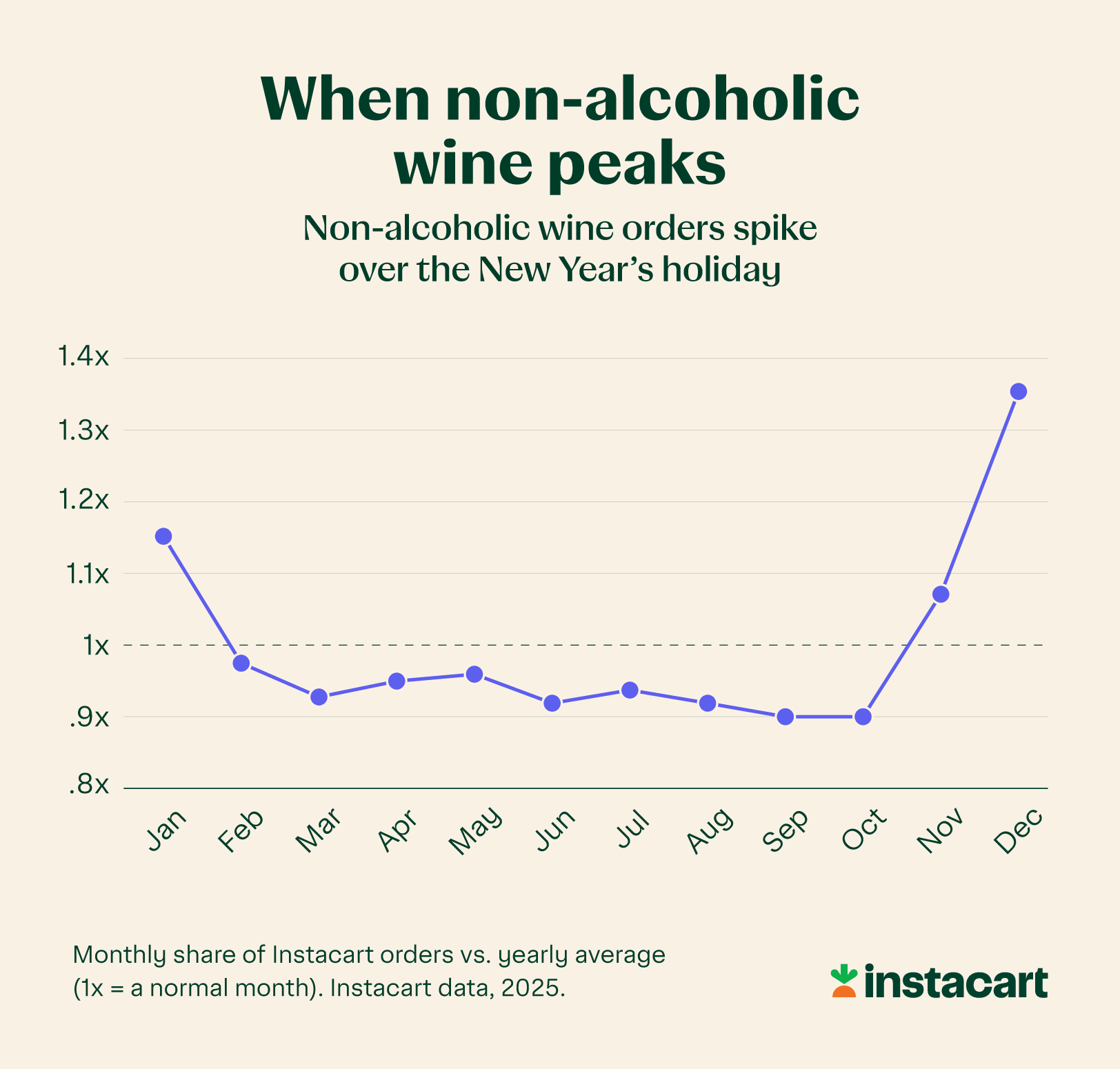
Non-alcoholic wine peaks at the same time as Champagne. Its busiest week was New Year’s Eve.
People shop for the whole drink, not just the bottle. About 1 in 5 gin orders included tonic water, and about 1 in 5 spiced rum orders included cola.
The alcohol ordering calendar, holiday by holiday
St. Patrick’s Day, New Year’s Eve, Christmas, Cinco de Mayo, and July 4 brought the biggest alcohol order spikes in Instacart’s data. That fits: these are days built around celebrating with friends and family, and most of them have a drink to go with them. St. Patrick’s Day is the biggest holiday for alcohol orders by spike size, led by stout.
Some holidays have one signature drink. Others shape a whole season. Several summer drinks, from canned vodka cocktails to piña colada mixers, peak between Memorial Day and early July. Passover, Halloween and Thanksgiving bring smaller lifts that still show up every year.
Here’s how each holiday plays out:
St. Patrick's Day
Stout is the drink of St. Patrick’s Day, and often an ingredient, too. Its share of orders jumped to about five times normal that week. Corned beef appeared in about 1 in 51 stout orders, a common braising ingredient. Irish whiskey orders about doubled during the same week.
Passover
Fruit wine orders rise the week Passover begins. Its share of orders rises about 1.5 times the week Passover begins, even as the date moves each year. In 2024, when Easter came 3 weeks earlier, the lift waited for Passover. Matzah shows up in about 1 in 200 fruit wine orders, about 22 times as often as in Instacart orders overall.
Cinco de Mayo
If margaritas are on your Cinco de Mayo menu, don't forget the extras for the glass. Margarita mixers hit about 2.5 times their usual share around May 5, while cocktail rimmers, the salt or sugar for the glass rim, climb as high as four times usual. Lime juice also lands in about 1 in 8 rimmer orders. Add a few dishes to round out the celebration with these Cinco de Mayo food ideas.
Memorial Day to July 4
Summer orders are built for the cooler. Canned cocktails lead the season: canned vodka cocktails about double their normal share of orders the week of July 4 every year, and canned gin, tequila, and rum cocktails peak around the same time. Body sunscreen shows up in about 1 in 68 canned vodka cocktail orders, 8 times as often as in Instacart orders overall.
Frozen and tropical drinks follow the same summer calendar. Piña colada mixers reach about 3.5 times normal between mid-June and early July, daiquiri mixers about triple in early July, and alcoholic ice cream and popsicles run more than 3 times normal from Memorial Day through July 4. For larger gatherings, summer cocktails offer easy options to mix by the pitcher.
Beer, seltzer, and rosé also see summer peaks, with orders topping out around July 4. Some pairings reflect the season, too. Limes appear in about 1 in 8 Mexican-style lager orders, making them a common addition to summer beer runs.
Halloween and Thanksgiving
Fall is a quieter season for alcohol orders. Hard cider peaks around Halloween at about 1.5 times its normal share. Riesling, red blends, and Moscato also peaked that week in 2024 and 2025, at about 1.5 times their normal levels. Wine’s biggest weeks still come in late December.
Christmas
At Christmas, customers order cocktail ingredients like liqueurs, dark rum, and bitters. Liqueurs and dark rum each run about three times their normal share of orders that week, and bitters about 2.5 times. Canned cherries show up in about 1 in 6 bitters orders, a common Old Fashioned garnish. Eggnog appears in about 1 in 78 multi-serve whiskey cocktail orders.
Brandy and Cognac about double, and chocolate wine reached nearly 4 times normal in 2025. Bourbon, Scotch, pinot noir, and cabernet sauvignon saw smaller lifts. With liqueurs and bitters peaking at the same time, it’s a good week for batch cocktails that serve a crowd.
New Year's Eve
New Year’s Eve belongs to sparkling wine. Champagne, cava, and sparkling wine each hit about three times their normal share of orders that week, with Prosecco close behind. Orange juice shows up in about 1 in 6 Champagne orders and 1 in 7 Prosecco orders, a combination that fits New Year’s Day mimosas.
Non-alcoholic drinks peak on the same holidays
Non-alcoholic drinks follow a seasonal pattern similar to alcoholic drinks. People buying zero-proof options are celebrating the same occasions, not necessarily saving them for January.
Non-alcoholic wine sees its biggest week around New Year’s Eve, when its share of orders rises to a little over twice normal. It also stays elevated throughout December, at about 1.5 times its usual share. Non-alcoholic spirits peak during that same week, reaching about twice normal, while non-alcoholic beer gets a smaller summer bump around July 4. Despite the focus on drinking less in January, none of these categories reached a peak that month in the 3 years studied.
Customers often pair these zero-proof drinks with mixers, too. Sparkling juice appears in about 1 in 24 non-alcoholic cocktail orders and 1 in 25 non-alcoholic wine orders. Tonic water also shows up in about 1 in 25 non-alcoholic spirit orders.
Alcohol delivery trends: what customers add to the cart
Most people don’t order a bottle on its own. They order the whole drink, and often the meal that goes with it. The strongest pairings in Instacart’s data are classic cocktails, cheese-board staples, and cooking ingredients, which shows that many alcohol orders are planned around a specific recipe or occasion.
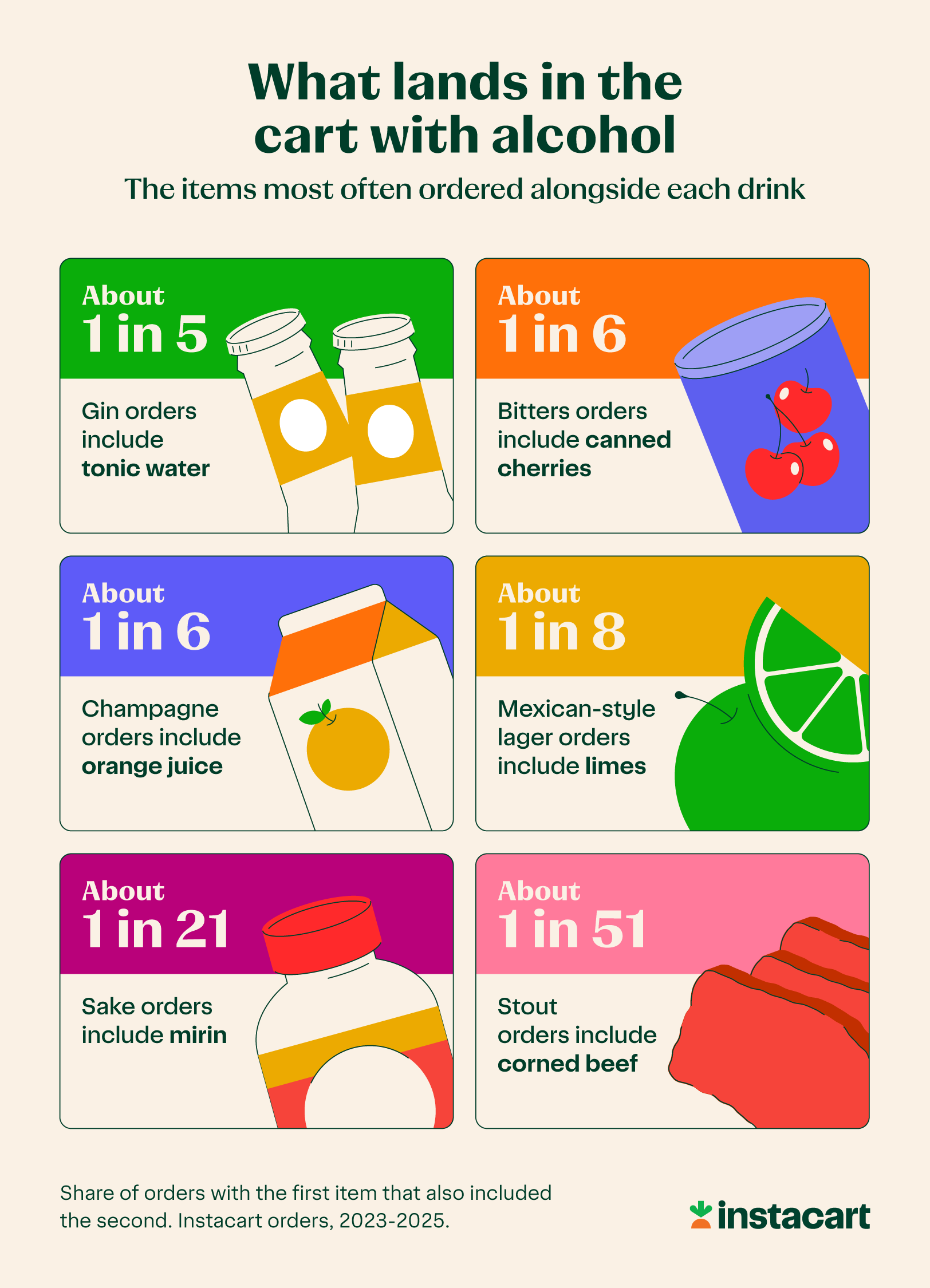
Each pairing below shows how often orders with one item also include the other.
Mixers: customers buy the whole cocktail
The most common mixers in alcohol orders are the ones behind classic cocktails. About 1 in 5 gin orders include tonic water, roughly 92 times as often as in Instacart orders overall. Cola is just as common with rum: It shows up in about 1 in 5 spiced rum and gold rum orders, and in about 1 in 6 American whiskey orders.
Other pairings point to specific drinks. About 1 in 6 bitters orders include canned cherries, a common Old Fashioned and Manhattan garnish. About 1 in 9 flavored rum orders include pineapple juice, and about 1 in 15 black rum orders include ginger beer. Bloody Mary mixer orders often come with vegetable juice (about 1 in 15) or horseradish (about 1 in 30), and about 1 in 27 unflavored vodka orders include cranberry juice.
Food: grill staples and cheese-board favorites
Food pairings are less common than mixers, but a few stand out. Mojito mixers sometimes land in the same order as grilled food. About 1 in 21 mojito mixer orders include chicken kabobs, roughly 34 times as often as in Instacart orders overall. Bratwurst shows up in about the same share.
Wine orders often include cheese and deli items. About 1 in 27 orange wine orders include Gouda. Vermentino pairs with olive bar items (about 1 in 37 orders), and sangiovese with prosciutto (about 1 in 51).
Beer orders come with snacks. About 1 in 53 light lager orders include French onion dip.
Cooking: some bottles are bought for the recipe
Sake orders are about 150 times more likely to include mirin than Instacart orders overall, reflecting how often the two appear together in Japanese cooking. Beef broth also frequently appears alongside merlot, while fresh thyme is a common addition to sherry orders. Both ingredients work well in braises and pan sauces. Merlot can complement a steak dinner, too. Explore which wines pair best with steak when planning your next meal.
How to plan your holiday drink orders
A little planning can make holiday drink orders easier and help keep your favorite drinks on hand for seasonal gatherings.
Check stock, then choose your delivery time
Popular bottles can run low around holidays. Check what’s in stock at local stores, then get it delivered the same day, where available, or schedule delivery for when you need it. Delivery options and hours vary by state and retailer.
Add the mixers and the meal to the same order
Plan the drinks and the meal together. Add stout, corned beef, cabbage, and potatoes to the same St. Patrick’s Day order, or sparkling wine, orange juice, and fresh fruit for New Year’s Day brunch. Get it delivered the same day, where available.
Include non-alcoholic options
If you’re hosting, add a few zero-proof options to the same order, with sparkling juice or tonic water to mix.
Grab it now on Instacart


Order holiday drinks through Instacart
These alcohol ordering trends show how customers can plan for the whole occasion. Order through Instacart to add the bottle, mixers, and meal to your cart in one order, with alcohol delivery from local retailers.
Alcohol is for adults 21+, where available. Enjoy responsibly.
Methodology
The alcohol ordering trends in this report are based on anonymized, aggregated Instacart orders placed from January 2023 through December 2025, primarily in the U.S. We analyzed 141 alcohol and cocktail-accessory categories, and the holiday patterns reflect U.S. holidays.
Seasonal figures compare each category’s share of orders in a 7-day window to its yearly average. “Twice normal” means the category accounted for twice its average share of orders that week.
The busiest week is the 7-day window with the category’s highest share of orders in a given year. Patterns described as repeating appeared in all 3 years; 2-year patterns are labeled with the years they occurred.
Which holidays are included: We included other holidays that showed a lift in all 3 years, either in the holiday week or the weeks around it. Other holidays we tested didn’t show a consistent pattern in all 3 years.
Pairings show the share of orders with one item that also include another. “Times as often as in Instacart orders overall” compares that share with how often the second item appears across all orders.
Rounding: Figures are rounded for readability. Ranges are given only where results varied widely across years.
Purchases, not consumption: The data reflects what customers ordered, not what they drank.


