What’s in your cart says a lot about the time of year, and about what’s catching customers’ interest. These grocery shopping statistics from Instacart data show when produce like pumpkins and sage peak and which foods, like sweet potatoes and Greek yogurt, are gaining ground.
The findings draw on 2 Instacart datasets: one covering 3 years of fresh produce orders from U.S. and Canadian retailers (2023–2025), and The Macro Moment, a report on U.S. grocery searches and sales from the first half of 2026.
Key grocery shopping stats from Instacart data
Cranberries’ basket share (their share of all items in Instacart orders) jumped to 1,561% above its yearly average during Thanksgiving week 2025, the biggest seasonal spike of the produce categories Instacart tracked.
Black Beauty eggplant grew its basket share 378% from 2023 to 2025, the biggest gain of the 258 produce categories Instacart tracked.
Lychees more than doubled their basket share (+105%) from 2023 to 2025, while Muscadine grapes doubled theirs (+100%).
Corn husk purchases peaked during Christmas week in each year studied, with their basket share reaching 1,327% above its yearly average in 2025.
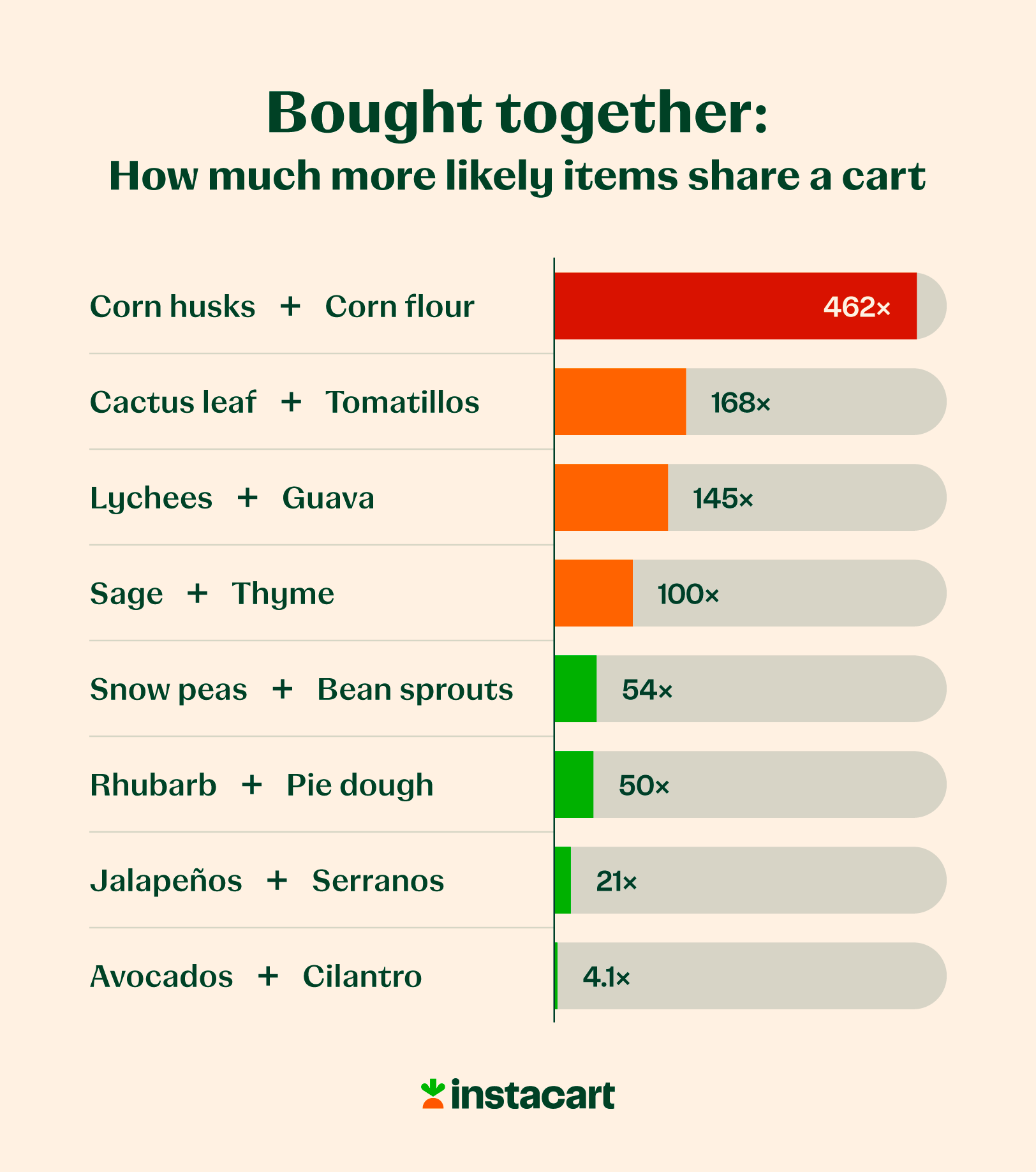
Compared to a typical Instacart order, orders with corn husks were 462 times as likely to include corn flour.
The share of Instacart searches that included “fiber” rose 26.4% year over year in the first half of 2026.
What grocery items do customers buy together?
From berries and tropical fruit to ingredients for salsa and tamales, Instacart order data highlights the foods that tend to show up together in grocery carts.
These grocery shopping stats offer a glimpse into popular ingredients and food combinations to consider when planning your grocery list. Each stat compares how often an item appears in Instacart orders that include its pairing, versus how often it appears across all Instacart orders. For example, orders with corn husks were 462 times as likely as a typical Instacart order to include corn flour.
The figures show which pairings are more common than expected, though they don’t measure overall popularity or explain why people buy these foods together.
1. Compared to a typical Instacart order, orders with corn husks, a tamale staple, were 462 times as likely to include corn flour and 312 times as likely to include dried peppers.
2. Orders with cactus leaf were 168 times as likely as a typical order to include tomatillos and 115 times as likely to include chayote squash.
3. Lychees often share a cart with other tropical fruit. Orders with lychees were 145 times as likely as a typical order to include guava and 114 times as likely to include Hami melons.
4. Holiday herbs tend to land together. Orders with sage were 100 times as likely as a typical order to include thyme, and orders with cranberries were 30 times as likely to include rosemary.
5. Rhubarb orders were 50 times as likely as a typical order to include pie dough.
6. Stir-fry vegetables show up together. Snow pea orders were 54 times as likely as a typical order to include bean sprouts and 33 times as likely to include bok choy.
7. Salsa and guacamole ingredients cluster in the same orders, too. Orders with jalapeños were 21 times as likely as a typical order to include serrano peppers and 12 times as likely to include cilantro, while orders with avocados were about 4 times as likely to include cilantro and 3 times as likely to include red onions. To put these ingredients to work, check out our guides to making salsa and guacamole.
8. Everyday pairings are more modest. Orders with strawberries were about 4 times as likely as a typical order to include blueberries or blackberries, orders with bananas were 3 times as likely to include Honeycrisp apples, and orders with asparagus were 6 times as likely to include salmon fillets.
The pairings offer ideas for ingredients to add to a meal or grocery list. If you shop for a parent or relative, these pairings can help you build their list. For more help, see our guides on how to grocery shop online or arrange grocery delivery for seniors.
Grocery shopping trends in produce: what’s gaining and losing ground
The trends in Instacart’s 2023–2025 produce data point to customers branching out, with newer and specialty varieties earning a larger share of the cart while some long-standing favorites lose ground. The table below ranks the 10 biggest gainers, and the stats that follow show where those shifts are happening within familiar aisles.
Fastest-growing produce on Instacart, 2023–2025
Rank | Produce category | 2–year change in basket share (2023–2025) |
1 | Black Beauty eggplant | +378% |
2 | Cosmic Crisp apples | +333% |
3 | Gray zucchini | +207% |
4 | Slicing cucumbers | +195% |
5 | Tri-color corn | +194% |
6 | Alfalfa sprouts | +139% |
7 | Cocktail tomatoes | +108% |
8 | Lychees | +105% |
9 | Muscadine grapes | +100% |
10 | Prickly pears | +99% |
How basket share is shifting within produce aisles
9. Vegetables dominate the biggest gains. Of the 10 fresh-produce categories that grew basket share the most from 2023 to 2025, 6 are vegetables in the kitchen sense: eggplant, zucchini, cucumbers, corn, alfalfa sprouts, and cocktail tomatoes.
10. Specialty fruits are climbing outside the top 10, too. Golden kiwis (+77%) and donut peaches (+54%) both gained basket share in 2 years.
11. In the citrus aisle, mandarins are pulling ahead. Dekopon mandarins, a larger, easy-peel variety, grew their basket share 89%, and standard mandarins grew 48%, while clementines (-19%) and navel oranges (-12%) lost basket share.
12. The apple aisle is shifting, too. Cosmic Crisp apples rank among the top 10 produce gainers, and Ginger Gold apples’ basket share grew 55%. Meanwhile, Gala (-24%) and Fuji (-27%) apples lost basket share, while Cripps Pink apples, a tart, crisp variety, held steady.
13. Hatch chiles are heating up. Their basket share grew 67% from 2023 to 2025.
14. Bing cherries saw the steepest 2-year decline in basket share of any produce category (-78%), even as sweet cherries (+96%), Rainier cherries (+55%), and red cherries (+53%) all gained basket share.
15. White corn (-56%), Manzano bananas (-44%), San Marzano tomatoes (-42%), and banana peppers (-41%) round out the biggest 2-year declines in basket share.
16. Everyday staples saw single-digit shifts. Bananas (-6%), strawberries (+5%), cilantro (+5%), and blueberries (+7%) all stayed within 7% of their 2023 basket share.
17. A few staples gained basket share from 2023 to 2025, led by green grapes (+25%), Hass avocados (+13%), white garlic (+11%), and yellow onions (+8%).
How seasons and holidays drive grocery shopping decisions
Each season brings its own produce peaks on Instacart. Fall and winter holidays drive most of the biggest spikes, while spring and summer peaks follow cookout holidays and stone fruit season. Staples like bananas, baby carrots, and onions show little week-to-week variation year-round, though.
The figures below show how far a category’s basket share rose above its yearly average in its 2025 peak week.
Fall and winter holidays
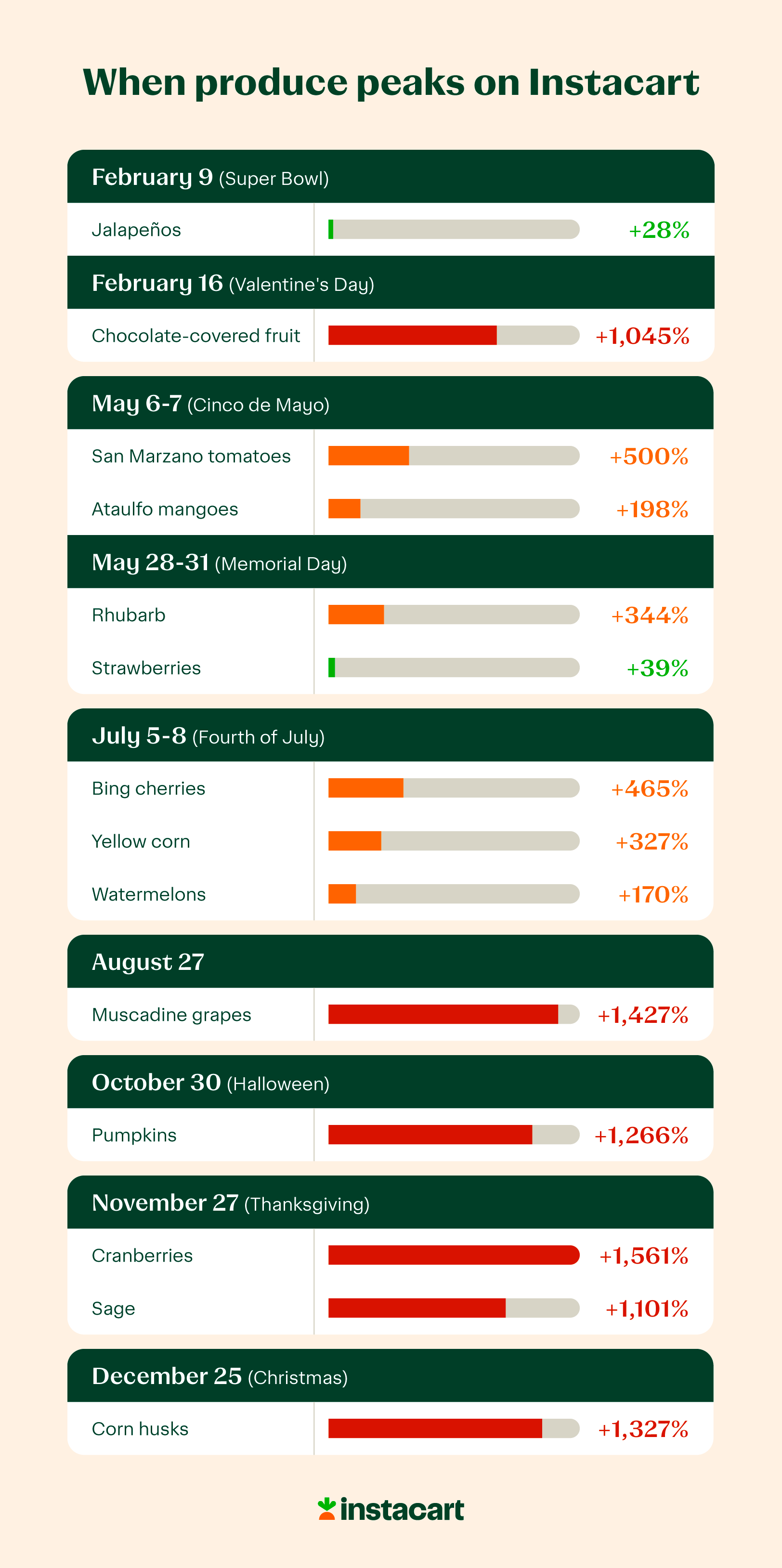
18. Pumpkins' basket share hit 1,266% above its yearly average during Halloween week 2025, and pumpkins peaked in Halloween week in each year studied.
19. Cranberries' basket share surged to 1,561% above its yearly average in the week ending November 27, 2025, the biggest seasonal spike of any produce category. Their overall basket share also grew 35% from 2023 to 2025.
20. Thanksgiving week lifts the herb and greens aisle. Sage (+1,101%), collard greens (+561%), and mustard greens (+417%) showed the biggest peaks in 2025.
21. Side-dish vegetables peaked that same week, led by sweet potatoes (+173%) and butternut squash (+132%).
22. Corn husks' basket share peaked at 1,327% above its yearly average in Christmas week 2025, and corn husks peaked in the same week in each year studied as tamale season arrived. Their basket share also grew 36% from 2023 to 2025.
23. Christmas week also lifts herbs and roasting vegetables, led by chives (+169%), parsnips (+136%), and tarragon (+130%).
Late winter and spring
24. February 2025 brought a pair of peaks. Chocolate-covered fresh fruit’s basket share jumped to 1,045% above its yearly average the week of Valentine’s Day, and jalapeños peaked during the week of the big game in early February (+28%).
25. Spring peaks arrive in May. San Marzano tomatoes (+500%) peaked in early May 2025, even as their overall basket share declined from 2023 to 2025, and rhubarb (+344%) peaked around Memorial Day.
Summer
26. Bing cherries (+465%), yellow corn (+327%), and watermelons (+170%) reached their 2025 peaks during Fourth of July week.
27. Stone fruit and chiles peak in summer, too. Rainier cherries peaked at 786% above their yearly average in the week ending July 10, 2025, which included the Fourth of July, and Hatch chile peppers peaked at 280% in mid-August 2025.
28. Muscadine grapes had the second-biggest seasonal swing of any produce category in 2025, behind only cranberries. In the week ending August 27, 2025, their basket share rose 1,427% above its yearly average, while in their slowest week it fell 99% below.
Seasonal ingredients see the most demand during holiday weeks, so a little planning goes a long way. Plan your meals a week or so ahead, pick up sturdier items like sweet potatoes, squash, and corn husks first, and save fresh herbs and berries for the last few days before you cook. You can also schedule your order for a delivery window that works for you, where available. If you’re watching costs, these tips on how to grocery shop on a budget can help.
How healthy eating is shaping the grocery basket
Instacart’s 2023–2025 data analysis shows how produce shifted over 3 years and from season to season. A separate Instacart report, The Macro Moment, points to a different kind of change. It compares U.S. searches and items sold in the first half of 2026 with the same period in 2025 and finds growing interest in protein- and fiber-rich foods.
Instacart classified foods as high in protein or fiber using public nutrition guidance.
What customers searched for
29. The share of Instacart searches that included “fiber” grew 26.4% in the first half of 2026 compared with the same period in 2025, about twice the growth rate of “protein” searches (+12.7%). (The Macro Moment)
What customers bought
30. Of the 10 categories that gained the most share of all items sold in the first half of 2026, 8 are high in protein or fiber. (The Macro Moment)
31. Produce leads the high-fiber gainers. Sweet potatoes ranked first among high-fiber categories by absolute gain in share of items sold. Their share also grew 28%, the largest percentage increase in the group. Next in percentage growth came frozen edamame (+25%) and dried prunes (+23%), followed by yams and D’Anjou pears (+20% each). (The Macro Moment)
32. Ranked by absolute gain in share of items sold, Greek and Icelandic yogurt and whole eggs led all high-protein categories. Their percentage growth in share was smaller, at 8% and 7%, because both already make up a large slice of the cart. Protein drinks' share of items sold grew 15%. (The Macro Moment)
33. Snack-friendly proteins gained ground, too. The shares of items sold for cottage cheese and string cheese each grew 10%, and protein bars’ share grew 9%. Among high-protein categories, ground chicken (+25%) and chicken salad (+20%) posted some of the largest percentage gains in share. (The Macro Moment)
34. Canned sardines’ share of items sold grew 51% year over year in the first half of 2026, the largest percentage gain of any category on Instacart’s lists of top high-protein and high-fiber gainers. Instacart’s report credits specialty tinned fish brands with leading the surge. (The Macro Moment)
New protein products
Protein isn’t just for shakes and bars anymore. It’s showing up in cereal bowls, freezer aisles, and even the toaster, as brands add a protein boost to foods customers already know. Instacart measured how quickly these products caught on by tracking each one’s share of its own category, and several posted big gains.
35. A protein toaster pastry launched in late 2025. It grew its share of its category 542% between December 2025 and June 2026. (The Macro Moment)
36. A protein cereal grew its share of the cereal category 157% year over year (June 2026 vs. June 2025). (The Macro Moment)
37. Protein versions of other breakfast and freezer staples are catching on, too. Protein frozen waffles' share of their category grew 101%, and high-protein ice cream pints' share grew 85% year over year (June 2026 vs. June 2025). (The Macro Moment)
Want to try the trend at home? These high-protein meals and cottage cheese recipes are a good place to start.
Protein and fiber picks to add to your cart
Shop the protein- and fiber-rich categories that gained ground on Instacart in the first half of 2026.
Grab it now on Instacart


Grocery shopping trends to try next
These 5 grocery industry trends point to simple ways to shop smarter in the year ahead.
Try a newer produce variety. Cosmic Crisp apples and dekopon mandarins gained basket share from 2023 to 2025. If you tend to buy the same apples or oranges every week, swap in one of these for a change of pace (stats 11–12).
Keep an eye out for specialty fruit. Prickly pears, golden kiwis, and donut peaches all gained ground over 2 years. Adding one to your next order is an easy way to try something new (the table and stat 10).
Plan holiday produce around peak weeks. Corn husks and pumpkins peaked in the same week in each year studied, so holiday demand tends to follow a predictable calendar. Build your list a week or so ahead and schedule your order in advance to make holiday prep a little easier (stats 18 and 22).
Follow the fiber trend. Searches for “fiber” grew about twice as fast as searches for “protein,” and sweet potatoes, frozen edamame, and D’Anjou pears were among the fastest-growing high-fiber categories (stats 29 and 31).
Check familiar aisles for protein versions. Protein versions of cereal, waffles, and toaster pastries grew quickly in their categories, so you may find one next to the version you already buy (stats 35–37).
Fill your cart with this year's grocery shopping trends
Use the grocery shopping statistics in this report to plan meals around produce when it’s most in demand, like cranberries and sage in late November or corn and cherries around the Fourth of July. When your list is ready, order your groceries through Instacart for delivery or pickup from stores near you.
For more ideas, browse these high-protein meals or the year’s top food trends. For more Instacart data, see Instacart’s grocery trends report.
FAQ
What are the biggest grocery shopping trends in 2026?
Instacart’s grocery shopping stats show that specific produce varieties like Cosmic Crisp apples and dekopon mandarins gained basket share from 2023 to 2025, and protein- and fiber-rich foods led growth in the first half of 2026.
What produce is growing fastest?
Black Beauty eggplant grew its basket share 378% from 2023 to 2025, followed by Cosmic Crisp apples (+333%), gray zucchini (+207%), slicing cucumbers (+195%), and tri-color corn (+194%).
Which grocery items are especially likely to appear in the same order?
Items especially likely to share an order include corn husks and corn flour (462 times as likely as a typical Instacart order), cactus leaf and tomatillos (168 times as likely), and lychees and guava (145 times as likely). Note that these figures show relative likelihood, not the most frequently purchased combinations.
When do people buy the most seasonal produce?
The biggest spikes match holiday menus. Cranberries peak during Thanksgiving week, pumpkins at Halloween, and corn and cherries around the Fourth of July.
Methodology
All data comes from Instacart’s first-party records of orders and searches on the Instacart marketplace. This data reflects activity on Instacart, not the full grocery market, and doesn’t measure the growth of online grocery shopping or grocery store customer demographics.
All figures come from Instacart data, 2023–2025, including Instacart’s first-party records of orders and searches on the Instacart marketplace. They reflect activity on Instacart, not the full grocery market.
The Macro Moment covers U.S. searches and items sold on Instacart. Share of items sold is a category’s share of all items sold on Instacart. Unless noted, figures compare the first half of 2026 with the first half of 2025. Instacart classified foods as high in protein or fiber using public nutrition guidance.