Today marks a historic milestone for millions of women, infants, and young children across America.
After years of work by policymakers, advocates, retailers, and public health leaders, the U.S. Department of Agriculture has finalized a rule that will allow WIC benefits to be used online — modernizing one of our nation's most important nutrition programs for the digital age.
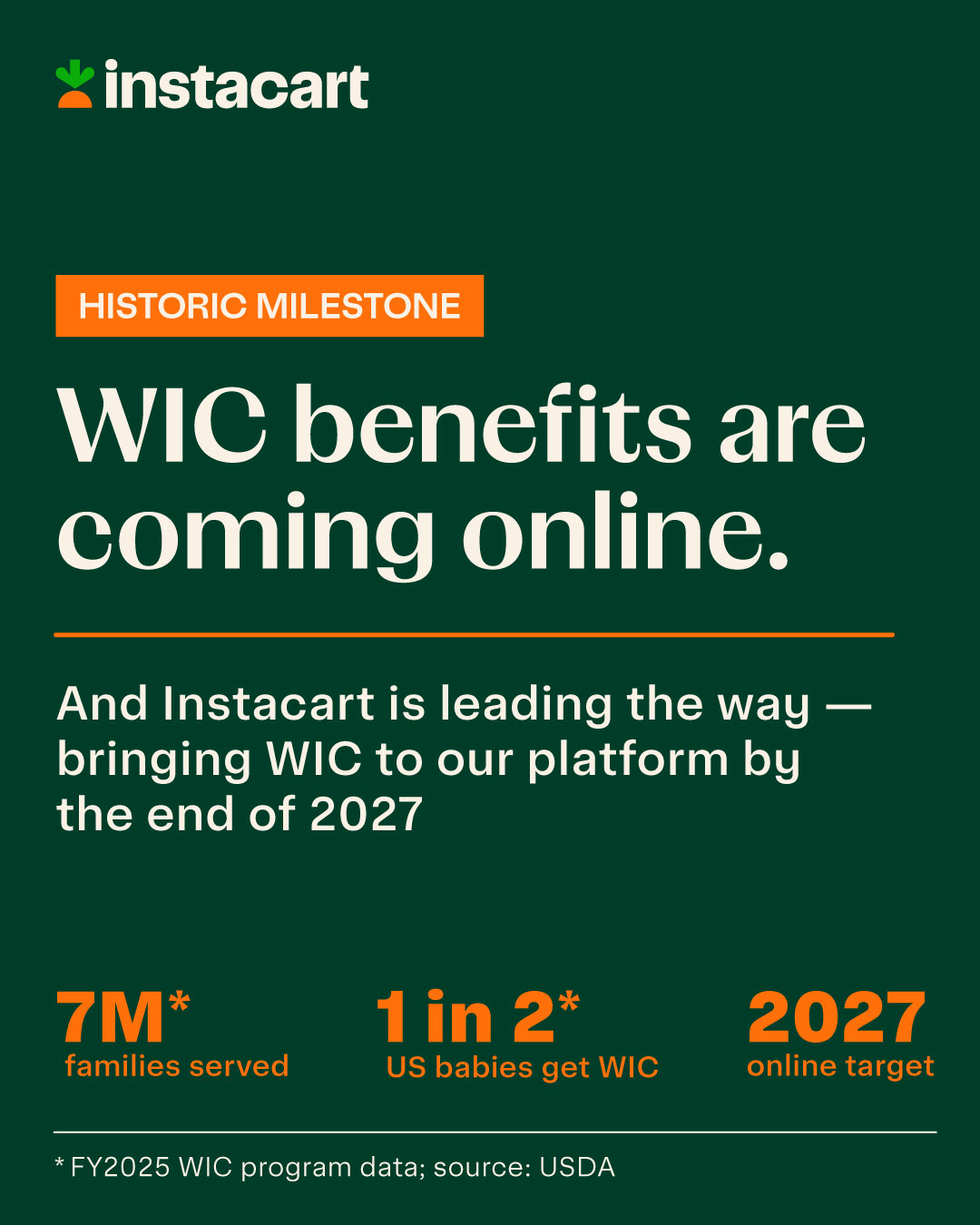
For more than 50 years, WIC (formally, the Special Supplemental Nutrition Program for Women, Infants, and Children) has been one of America's most successful public health investments. Today, the program serves nearly 7 million women, infants, and young children, and nearly half of babies born in the U.S. receive WIC benefits during their first year of life.1
At Instacart, we've long believed families who use WIC deserve the same convenience, flexibility, and access to online grocery that millions of SNAP participants already count on to get the food and essentials they need. That's why we've spent years advocating for this very moment.
That’s also why today, we're proud to announce that Instacart is actively working to bring WIC online, and we’re committed to bringing WIC payment to our platform by the end of 2027. Ultimately, we hope to be able to support families who use WIC- in all 50 states and the District of Columbia, just as we do today for SNAP benefit recipients.
Advocacy carries a responsibility to help deliver results. This commitment reflects our belief that when government creates new opportunities to expand food access and improve affordability, the private sector should step up alongside it to help make those opportunities a reality.
This program’s impact is particularly profound. Research has consistently shown that WIC participation improves maternal and infant health, strengthens childhood nutrition, supports healthy cognitive development, and reduces healthcare costs.2 Long before the concept of food as medicine became part of our national conversation, WIC demonstrated how better access to nutritious food has the power to improve health outcomes for families.
But while the way Americans live and shop has evolved dramatically in recent decades, for the most part, WIC participants are still required to redeem their benefits in person. For working parents, families living in rural communities, individuals without reliable transportation, and mothers caring for newborns, that requirement can create real barriers to accessing healthy food.
In addition, research by No Kid Hungry and the University of Kentucky found that families living with lower incomes who grocery shop online purchase over $5 more in fruits and vegetables without increasing their overall grocery bill, while also saving time and experiencing less perceived stigma compared to using SNAP benefits in-store.
That’s why today's announcement from USDA represents such an important milestone. Bringing WIC online will make one of America's most successful nutrition programs work even better for the families it’s designed to serve.
Imagine a new mother recovering after childbirth who no longer needs to make a separate trip to the grocery store to redeem her benefits. Imagine working parents spending less time navigating public transportation and childcare logistics and more time caring for their children. Imagine WIC benefits fitting more seamlessly into the way millions of families already shop for groceries today.
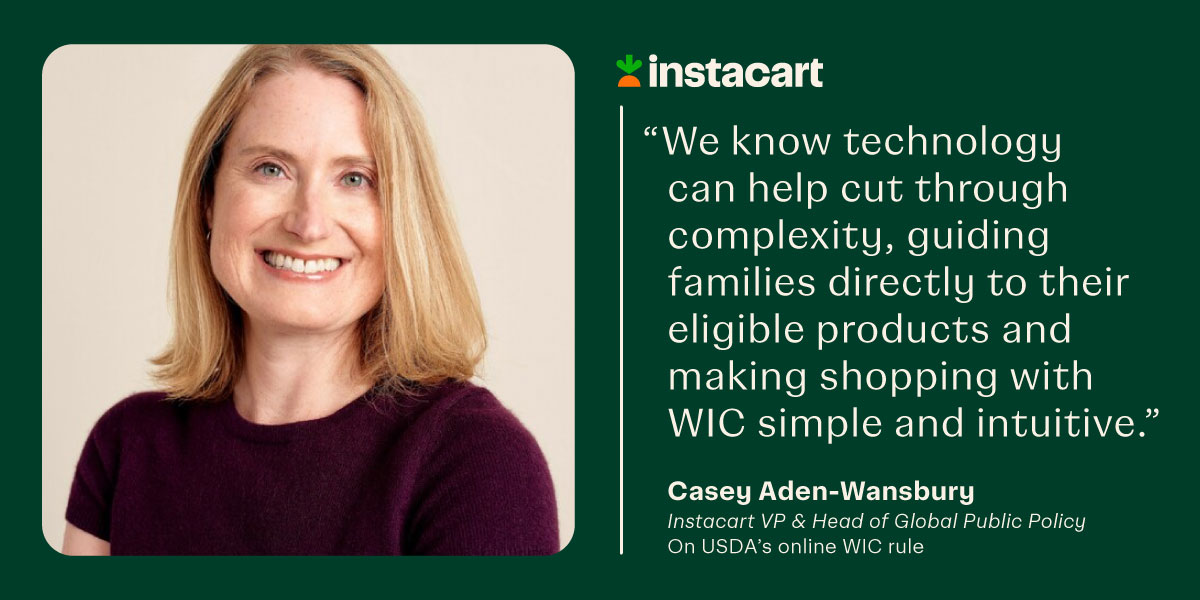
And the benefits extend beyond the convenience of delivery. Since WIC is a personalized food prescription program with specific approved items and quantity-based benefits, it's one of the most complex programs to use while shopping in person at a store. We know technology can help cut through that complexity, guiding families directly to their eligible products and making shopping with WIC simple and intuitive.
That's the promise of bringing WIC online. Not only on our marketplace, but also on the many retailer sites we power, so customers can redeem their benefits whether they're shopping on the Instacart marketplace or directly on their favorite grocer’s website.
“Giving busy moms the option to order groceries online with WIC puts nutritious food within reach for more kids and their families regardless of where they live,” said George Kelemen, senior vice president for Share Our Strength and its No Kid Hungry Campaign. “We commend the U.S. Department of Agriculture for advancing this innovative investment to modernize the WIC program and improve access to healthy food. This final rule will make it easier for rural communities to access this vital program that supports new moms, ensures healthier pregnancies and helps kids get the nutrition and resources they need during a vulnerable time. Simplifying grocery shopping for families takes one more task off their plates so they can focus on where they're needed most.”
We applaud Secretary Rollins and the U.S. Department of Agriculture, as well as the countless state and local leaders, advocates, retailers and researchers who have spent years working to modernize WIC and allow recipients to use their benefits online. This final rule marks one of the most significant advancements in the program's history, bringing millions of families one step closer to accessing nutritious food in the way so many Americans already shop today.
For Instacart, this moment is especially meaningful.
Access and affordability are at the heart of our mission. For years, we've proudly and loudly advocated for bringing WIC online. We’ve worked closely beside policymakers and advocacy organizations, including the National WIC Association, submitted comments and supported USDA's proposed rulemaking, shared research demonstrating the value of online grocery access for families with low incomes, and consistently encouraged policymakers to modernize one of America's most effective nutrition programs.
That advocacy has been rooted in our unique experience.
As the first grocery technology company to bring SNAP online in all 50 states, we've seen firsthand how expanding access to online grocery shopping can make a meaningful difference for families. We've also partnered with governments, healthcare organizations, retailers, and nonprofits to expand nutrition access through Fresh Funds programs, food as medicine initiatives, military family partnerships, and other efforts designed to make healthy food more accessible. Bringing WIC online is the natural extension of that work.
Turning this historic policy change into a seamless experience for families will require close collaboration among USDA, state WIC agencies, retailers, technology providers, and advocates. It will require thoughtful implementation, continued investment, and a shared commitment to ensuring every eligible family can benefit from this modernization.
This will be challenging and complex work. We’re ready to do our part.
We know firsthand what it takes to build secure, scalable online nutrition benefit programs. We also know that technology alone isn't enough. Success depends on strong public-private partnerships, close coordination with retailers and government agencies, and an unwavering focus on the families these programs exist to serve.
For decades, WIC has helped millions of families build healthier futures. Today's rule creates an opportunity to make the program even stronger. We're proud to have helped advocate for this moment, and we're even more excited to help build what comes next.
1 https://www.ers.usda.gov/topics/food-nutrition-assistance/wic-program