Making the perfect ham is simple when you follow the correct cooking times. Not sure how long to cook a ham? Use our simple ham cooking time calculator to find the estimated baking time for your meat. You can also order your ham and glaze ingredients through Instacart, with delivery or pickup from stores near you, to save time on prep day.
Short answer: Bake ham at 325°F. A fully cooked ham takes 10 to 30 minutes per pound, depending on the cut, and is ready at 140°F (or 165°F if it was repackaged at the store or is a leftover). A ham labeled “cook before eating” or a fresh ham takes 18 to 40 minutes per pound and must reach 145°F, then rest for 3 minutes.
To use the calculator, all you have to do is input the type of ham, cut of meat and its weight. You’ll then find out the ham’s temperature and cooking time in minutes.
How do you calculate ham cooking time?
According to the USDA, ham cooking time is calculated by the weight and cut of meat. For example, a fully cooked, whole bone-in smoked ham takes 15 to 18 minutes per pound to reheat at 325°F, while a cook-before-eating one needs 18 to 20 minutes per pound at 325°F. The ham cooking time calculator takes the weight of the meat and converts it into the average number of minutes it will take to reach the right internal temperature.
Cooking a different cut of meat? Try our cooking time calculator.
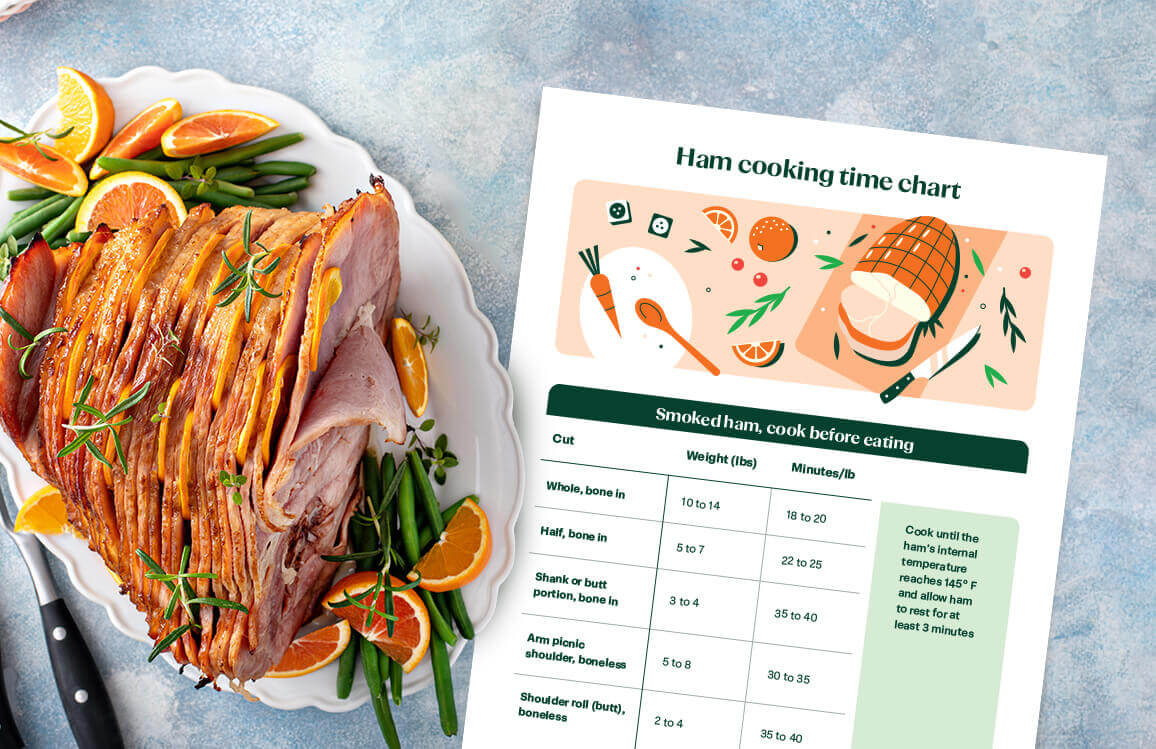
Ham cooking time chart [printable]
Our ham cooking time calculator tells you the average time to cook your meat. You can also use our printable ham cooking time chart to make sure you’re using the correct times when determining how long to cook a ham in the oven.
All times assume a 325°F oven.
Pro tips for the perfect ham
Cooking ham takes time, skill, and patience (of course). It’s important to know things like how long to cook a precooked ham vs. fresh meat, where to place the thermometer, and when to glaze. Here are some useful ham cooking tips and tricks you can put to the test.
Choose the right cut: Think about how you want to use the ham in your recipe. If you’re looking for the ham to be the main attraction, opt for bone-in for extra juiciness and flavor. Boneless or spiral-cut hams are easier to carve and faster to reheat.
Combat dryness: Since many hams sold in stores are fully cooked and only need reheating, preventing moisture loss is key. Set your oven to 325°F; higher heat dries the outside before the center warms through. Place your ham cut-side down in a roasting pan. Add about ½ inch of liquid (water, broth or cider) to the bottom of the pan and cover the entire ham tightly with aluminum foil. This will trap the steam, effectively basting the ham and preventing the surface from drying out. Uncover the ham when it’s time to glaze.
Score the ham: To help the glaze penetrate and to create a beautiful caramelized crust, use a sharp knife to score a diamond pattern across the fat layer of the ham before baking.
Don’t overcook it: Fully cooked ham dries out easily when it’s reheated. Bake an already-cooked ham to 140°F (or 165°F if it was repackaged or is a leftover). Bake a cook-before-eating or fresh ham to 145°F. Make sure you’re using a ham cooking time calculator and a reliable meat thermometer to track the internal temperature. Never rely solely on time to determine how long to cook ham.
Check placement: Insert the thermometer into the thickest part of the meat, making sure it doesn’t touch the bone or the fat cap.
Time the glaze: Wait until the final 20–30 minutes of cooking to apply your glaze. Applying it earlier can cause the sugars to burn, resulting in a bitter, hard crust.
Let it rest: After removing the ham from the oven, cover it loosely with foil and let it rest for 15–20 minutes. The USDA’s minimum rest for uncooked and fresh ham is 3 minutes, but a longer rest makes the ham easier to carve. Resting also allows the juices to redistribute, resulting in a moister, more tender slice.
Ham cooking supplies
Here are a few ham cooking supplies you may want to invest in.
Roasting pan and rack: You’ll need a roasting pan that’s large enough to cook your ham comfortably. It’s also important to have a roasting rack to ensure the heat circulates and your ham cooks thoroughly.
Meat thermometer: Avoid the guessing game and use a meat thermometer to measure the exact internal temperature of your ham. Uncooked and fresh ham should reach 145°F, and fully cooked ham should be reheated to 140°F, or 165°F if it was repackaged at the store or is a leftover.
Carving tools: Forget the hassle of cutting ham with regular knives and invest in carving tools. Make sure to buy a set that includes a knife and fork to make the process easier.
Cutting board: Sure, you can carve a ham without a cutting board, but it makes the process much messier. Look for a cutting board that has grooves on the edges to stop the juices from escaping as you carve.
Grab it now on Instacart


Ham cooking techniques
Knowing how long to cook ham isn’t enough to create an enjoyable meal. You also need to choose the right cooking method. There are several ways to cook ham, each offering unique flavors and textures. Whether you’re looking for a slow, tender result or a crispy finish, these methods will help you prepare a delicious ham for any occasion.
The cooking method changes how long ham takes, but not how hot it needs to get. Heat fully cooked ham to 140°F (165°F if it was repackaged at the store or is a leftover), and cook uncooked or fresh ham to 145°F, then let it rest for at least 3 minutes.

Braising: Braising involves cooking the ham slowly in a covered pan with a small amount of liquid. This technique keeps the ham moist and tender while infusing it with extra flavor from the broth, juice, or wine you choose. Braise until the thickest part reaches 140°F for a fully cooked ham or 145°F for an uncooked or fresh one.
Grilling: Grilling adds a smoky, charred flavor to the ham, great for outdoor gatherings. Slice the ham into thick steaks or place the whole ham on the grill, using indirect heat to cook it evenly while achieving that crispy, caramelized glaze on the outside. Grill ham steaks or a whole ham until they reach 140°F if fully cooked, or 145°F if uncooked or fresh.
Slow cooker: The slow cooker is ideal for hands-off cooking. Place a fully cooked half ham in the slow cooker with your choice of seasonings and liquids, and heat it on low until the thickest part reaches 140°F (165°F if it was repackaged or is a leftover), checking with a thermometer. The result is a juicy, fall-apart tender ham that absorbs all the flavors.
Air fryer: An air fryer gives ham a crisp, caramelized exterior while keeping the inside moist. Because the basket is small, it works best for ham steaks or a small boneless ham, which heat through faster than a whole ham in the oven. Cook until the center reaches 140°F for fully cooked ham or 145°F for cook-before-eating or fresh ham.
Ham recipe ideas

From Christmas food recipes and a traditional Christmas dinner to Easter dinner, there are endless ways to enjoy ham. Whether you’re cooking this versatile meat for a special occasion or just want a delicious meal, these ham recipe ideas are sure to impress. Want more ideas? Browse the Meals tab on Instacart, or ask Clementine to build a ham recipe around your preferences.
How to store ham
Now that you know how long to cook a fully cooked ham and fresh ham, it’s time to learn how to store it. Check out this chart based on USDA guidance to learn more about refrigerating and freezing your specific type of ham.
Ham cooking time FAQ
Still unsure about how long to cook a ham? Here are a few answers to commonly asked questions surrounding ham cooking times.
How long does it take to cook a 10 lb ham?
A 10 lb fully cooked whole bone-in ham takes 2.5 to 3 hours at 325°F (15–18 minutes per pound) to reach 140°F (165°F if it was repackaged or is a leftover). An uncooked 10 lb bone-in smoked ham takes 3 hours to 3 hours 20 minutes, and a 10 lb fresh boneless leg takes 4 hours to 4 hours 40 minutes. Both need to reach 145°F. Use our ham cooking time calculator to get the estimated time for your ham.
What should be the internal temperature of a ham?
The USDA recommends reheating a fully cooked ham to 140°F if it was packaged in a USDA-inspected plant, or 165°F for all other cooked ham, such as leftovers. Cook-before-eating and fresh ham should reach 145°F, then rest for at least 3 minutes.
How do I tell if ham is cooked or uncooked?
Check the label. “Fully cooked” or “ready to eat” means you’re only reheating it. “Cook before eating,” “cook thoroughly,” or “fresh” means it’s raw and must reach 145°F. If you’re unsure, treat it as uncooked.
How long does it take to cook smoked ham?
The estimated time to cook smoked ham will vary depending on the weight and cut of the meat. A 5 lb fully cooked half ham takes about 1 ½ to 2 hours, while a 7 lb spiral-cut ham needs about 70 minutes to just over 2 hours.
When should I apply the ham glaze?
Apply the glaze during the last 20–30 minutes of cooking to prevent burning. Glazing earlier can cause the sugars to caramelize too quickly, resulting in a bitter crust and preventing the glaze from developing its full flavor.
How do I prevent my ham from drying out?
To keep your ham moist, cover it tightly with foil and add a small amount of liquid to the pan, then uncover it for the last 20–30 minutes to glaze. Use a meat thermometer to make sure you don’t overcook the meat, preserving its juiciness.
Should I score a spiral-cut ham?
Spiral-cut hams don’t need scoring. Brush the glaze between the slices instead. This allows the glaze to penetrate better and enhances caramelization, resulting in a more flavorful and visually appealing crust. Plus, the leftovers make for a delicious addition to a breakfast casserole.
Do you cook a ham at 325°F or 350°F?
The USDA recommends an oven set no lower than 325°F, and its ham cooking charts are based on 325°F, too. A 350°F oven works, but the outside of the ham can dry out before the center warms, so start checking the temperature earlier.
Need to convert for a different oven? See our oven temperature conversion chart.
How long should a 5 lb ham be cooked?
A 5 lb fully cooked half ham takes about 1 ½ to 2 hours at 325°F. A 5 lb smoked, cook-before-eating half ham takes about 2 hours.
Is 2 hours long enough to cook a ham?
Two hours can be enough for smaller fully cooked hams, like a 5 lb half ham (1 ½ to 2 hours) or a 7 lb spiral-cut ham (about 70 minutes to just over 2 hours). A 10 lb fully cooked ham needs 2 ½ to 3 hours, and uncooked hams need longer. Always confirm with a thermometer.
How long do you cook a spiral ham?
Bake a spiral ham at 325°F for 10 to 18 minutes per pound, covered in foil, until it reaches 140°F (165°F if it was repackaged or is a leftover). A 9 lb spiral-cut ham takes about 1 ½ to 2 hours 40 minutes. Most spiral-cut hams are sold fully cooked, but check the label. If it’s fully cooked, you can also serve it cold.
How much ham do I need per person?
The USDA suggests planning on ⅓ to ½ lb per person for bone-in ham and ¼ to ⅓ lb for boneless. Add a little more if you want leftovers.
Cook the perfect ham with the right ingredients
There are so many factors to consider when cooking ham, from the weight to the cut of meat. With our ham cooking time calculator, you can find out the estimated time and temperature it’ll take to bake your ham. Not sure what to do with leftover ham? Check out our leftover recipe generator or ask Clementine for ideas about what you can make.
When you’re prepping a holiday dinner, focus your time on the cooking. Find ingredients for your ham feast, from the glaze to the sides, through Instacart, with delivery or pickup from stores near you.